Trombone and percussion
Acoustic Composition 28
Sacsayhuamán (2026)
For orchestra
For Robin
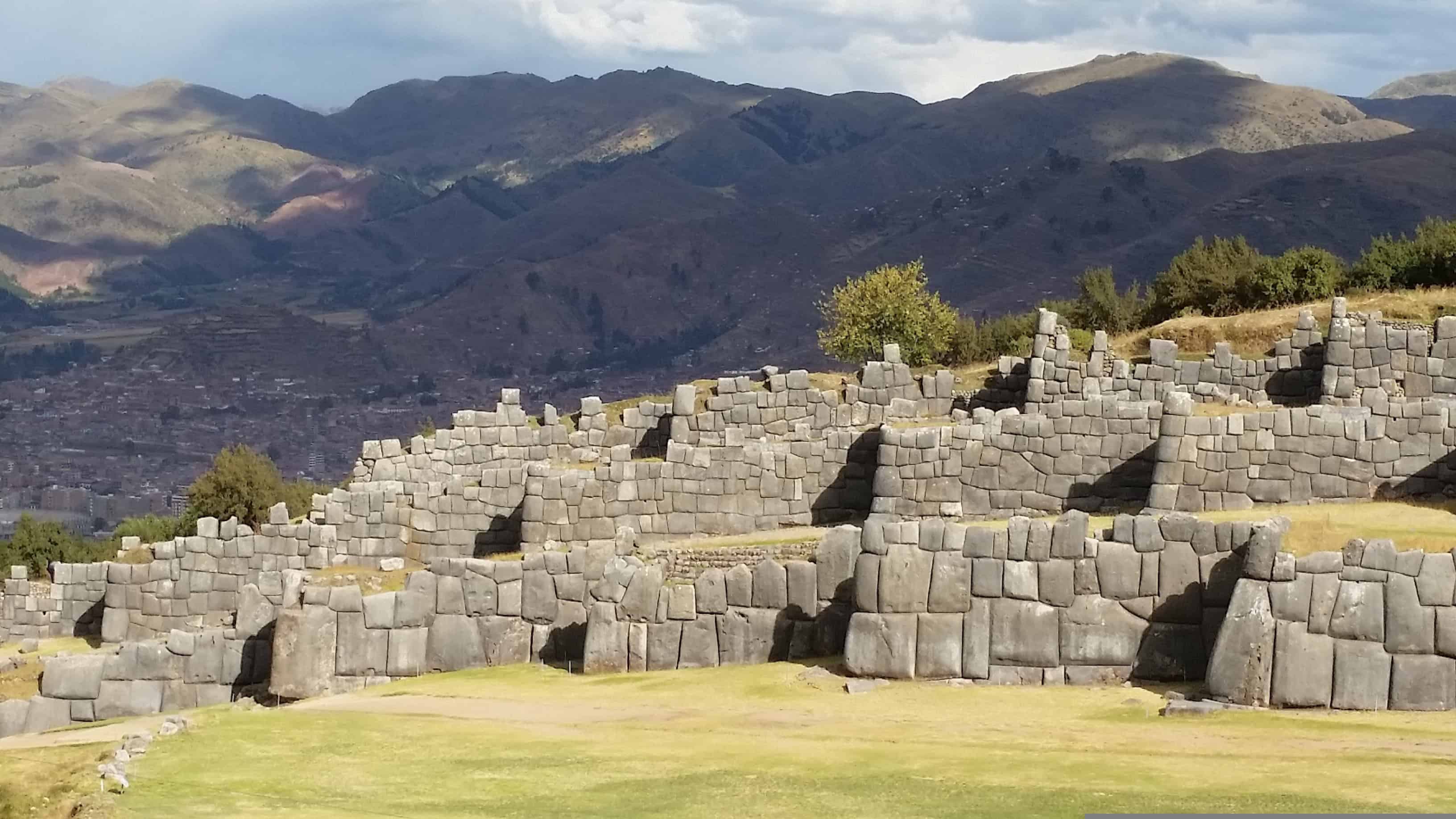
Sacsayhuamán
(SACK-sy-wuh-mən)
Sacsayhuamán is a three movement work written for orchestra. It is the culmination of a long and intricate journey of research which evolved through connected strands and intertwined theories over many years. The name (rather unsatisfyingly) translates into Satisfied Hawk, or Royal Falcon.
Theoretical preparation for this piece began during 2015 and actual composition in score form started in September 2019, but the research journey itself began much earlier with the use of East African equidistant pentatonic scales (the octave split into five equal steps of 2.4 semi-tones) in Equidistance - An African Hymn of Praise (2007), the use of an equidistant twelve-tone row (the cycle of fourths) within An Instant Conception (2009), the all-interval tetrachords (AIT) in Ensuen (2009/19), and the all-triad hexachord (ATH) in Rotations and Resonances (2012).
During 2014, time spent analysing Messiaen’s modes of limited transposition in preparation for a university lecture I was delivering led to the recognition they were all symmetrical palindromes and helped me to further recognise (in retrospect) that my own portfolio had also been dealing with symmetrical and asymmetrical pitch palindromes. These pitch-theories had evolved quite fluidly alongside a developing concept of Matryoshka forms (object within similar object) which had itself evolved out of the proportional form used in An Acoustic Mandala for the Fourteenth (2008/11), and took initial steps in the shape of the acousmatic work A Chance Encounter (2010/13), and then (later) in score form with The Palindrome Triptychs - Part Two: Ultima Thule (2017).
In a further period of precompositional planning and practical research, these pitch palindromes were documented in their many forms, from the unison, through the individual intervals, trichords, tetrachords, pentachords and hexachords onwards towards the twelve notes of the tempered scale, and variants on this theme such as Elliott Carter’s All-Interval Twelve-Note Chords (AITN) in Perhaps We Will All Wake Up In Time (2017), simple palindromic forms (and text) in Kyrie (2017), and palindromic twelve-tone rows within Matryoshka forms in Palindrome Triptychs - Part Three: Turning Water into Wine (2020).
Palindromes:
Palindromes1 are theoretically infinite, both infinitely large and infinitely small. Most people imagine palindromes as symmetrical absolutes with perfect reflections that read from a central axis expanding outwards on the horizontal or vertical plane, but palindromes can expand into panoptic space (360o) or at least into euclidean space2, and palindromes do not always have to be symmetrical or equidistant, they can also be asymmetrical, or proportional in augmentation and diminution e.g. The Golden Ratio, Fibonacci Sequence and Fractals.
It is well documented that Leonardo Da Vinci often used mirror-writing when annotating his research, but many believe he also employed mirror reflections within his art. It has been proposed that hand gestures often define a point of axis, or an ‘angle of reflection’ for the mirror, and through this, Da Vinci employed alternate reflections and mirror imitations to produce symmetrical, asymmetrical, parallel and inverted, subliminal and liminal visual palindromes.
As palindromes are theoretically infinite and potentially perfectly proportionate within a panoptic space, it is easy to see why they have long been considered spiritually significant and often elevated to the status of folkloric and religious iconography. Palindromes are both infinitely large and infinitely small; they are theoretically eternal.
1 A word or phrase, the letters (or components) of which, when taken in reverse order read the same. Collins English Dictionary, 1982.
2 A space in any finite number of dimensions, in which points are designated by coordinates (one for each dimension), the distance between two points is given by distance formula.
The Research Journey
Pitch Palindromes:
Apart from the single note (unison), the interval (the space between two notes) is the smallest pitch palindrome. There are six interval-classes and when used in multiple, they all complete an equidistant palindromic cycle.
Class 1: minor 2nd and Major 7th.
Class 2: Major 2nd and minor 7th.
Class 3: minor 3rd and Major 6th.
Class 4: Major 3rd and minor 6th.
Class 5: Perfect 4th and Perfect 5th.
Class 6: tritone/diminished 5th.
Class 1 and 5 are notable in the fact they cycle through the total chromatic before they repeat any notes. Class 1 will result in an equidistant row of total dissonance (chromatic octave) and Class 5 results in equidistant twelve-tone consonance (cycle of fourths/fifths).
Class 2 produces a six-note equidistant whole-tone scale, Class 3 results in a four-note equidistant diminished 7th chord, Class 4 results in a three-note equidistant augmented triad and Class 6 simply produces the two-note interval of a tritone. Apart from the single note, the interval (or micro-interval) is the smallest pitch palindrome.
The most succinct way of referring to all intervals and interval-classes was to compose with the two All-Interval Tetrachords (AIT) 4-z15 (0146/0256) and 4-z29 (0137/0467).
The AIT are subsumed within the two All-Triad Hexachords (ATH) 6-z17 (012478) and 6-z17b (014678).
The ATH in turn can be found in prime form within the Symmetrically Inverted All-Interval Twelve-Note (SI AITN) Chords: (Elliott Carter numbers) SI AITN 1, 3, 58 and 60.
In addition (and perhaps incidentally), Dorian Mode (Heptachord 7-35) is the only mode in the tonal system that inverts to itself: a tonal, or ‘natural’ palindrome. The Dorian Mode subsumes a transposition of its own complement; the Major Pentatonic Scale (Pentachord 5-35): another scalic palindrome.
The Cycle of Fourths:
The cycle of fourths can be described as a twelve-tone equidistant chromatic scale. Like the six notes of the equidistant whole-tone scale, there is no inherent hierarchical reference to a home-tone unless one is established through the act of composition. The cycle of fourths could also be described as a Mirror Inverted All-Interval Twelve-Note Chord; a palindromic chromatic cycle with multiple equidistant palindromes within its self-contained Matryoshka Form.

Click/Tap to View
The All-Interval Tetrachord (AIT):
4-z15 (0146/0256) and 4-z29 (0137/0467)
The two All-Interval Tetrachords (AIT) get their name due to the fact they contain all twelve interval-types without replication:
0146/0256 (4-z15/4-z15B) <111111> All-Interval Tetrachord 1
0137/0467 (4-z29/4-z29B) <111111> All-Interval Tetrachord 2

Click/Tap to View
The all-interval tetrachords (AIT) are self-contained palindromes:
0256 (4-z15b) is a retrograde inversion of 0146 (4-z15)
0467 (4-z29b) is a retrograde inversion of 0137 (4-z29)
AIT Pitch Matrices:
4-z15:
(0146/0256) <111111> All-Interval Tetrachord 1 (Inverts to 4-z15)
| 0 | 1 | 4 | 6 |
| 11 | 0 | 3 | 5 |
| 8 | 9 | 0 | 2 |
| 6 | 7 | 10 | 0 |
| C | C# | E | F# |
| B | C | Eb | F |
| G# | A | C | D |
| F# | G | Bb | C |
4-z29:
(0137/0467) <111111> All-Interval Tetrachord 2 (Inverts to 4-z29)
| 0 | 1 | 3 | 7 |
| 11 | 0 | 2 | 6 |
| 9 | 10 | 0 | 4 |
| 5 | 6 | 8 | 0 |
| C | Db | Eb | G |
| B | C | D | F# |
| A | Bb | C | E |
| F | Gb | Ab | C |
The All-Triad Hexachord (ATH):
(012478/014678) <322332> Carter Hexachord 35, Forte 6-z17 [6-z17b]
| 0 | 1 | 2 | 4 | 7 | 8 |
| C | C# | D | E | G | G# |
A hexachord is any sequence of six notes laid out in a scalic pattern. The All-Triad Hexachord (ATH) takes its name from the fact it contains all twelve prime-form trichords (without replication) within the span of an octave:
012 013 014 015 016 024 025 026 027 036 037 048
3-1 3-2 3-3 3-4 3-5 3-6 3-7 3-8 3-9 3-10 3-11 3-12
ATH list of prime-form trichords:
i. 3-1* (012) <210000> BACH/Chromatic Tri-mirror: C - C# - D
ii. 3-2 (013) <111000> Phrygian Trichord: C# - D - E
iii. 3-3 (014) <101100> Major-minor Trichord: C - C# - E
iv. 3-4 (015) <100110> Incomplete Major Seventh Chord: G - G# - C
v. 3-5 (016) <100011> Rite Chord/Tritone Fourth: C# - D - G
vi. 3-6* (024) <020100> Whole-tone Trichord: C - D - E
vii. 3-7 (025) <011010> Incomplete minor seventh Chord: D - E - G
viii. 3-8 (026) <010101> Incomplete Dominant Seventh Chord – Italian Sixth: D - E - G#
ix. 3-9* (027) <010020> Quartal Trichord: C - D - G
x. 3-10* (036) <002001> Diminished Chord: C# - E - G
xi. 3-11 (037) <001110> Major/minor Chord (047): C# - E - G#
xii. 3-12* [4] (048) <000300> Augmented Chord: C - E - G#
ATH Pitch Matrices:
The ATH is a self-contained (combinatorial) palindrome: 014678 is a retrograde inversion of 012478:
| 0 | 1 | 2 | 4 | 7 | 8 |
| 11 | 0 | 1 | 3 | 6 | 7 |
| 10 | 11 | 0 | 2 | 5 | 6 |
| 8 | 9 | 10 | 0 | 3 | 4 |
| 5 | 6 | 7 | 9 | 0 | 1 |
| 4 | 5 | 6 | 8 | 11 | 0 |
| C | C# | D | E | G | Ab |
| B | C | C# | Eb | F# | G |
| Bb | B | C | D | F | F# |
| Ab | A | Bb | C | Eb | E |
| F | F# | G | A | C | C# |
| E | F | F# | Ab | B | C |
The ATH subsume the AIT 0146/0256 and 0137/0467 in prime form:
| 0 | 1 | 4 | 6 | 7 | 8 |
| 11 | 0 | 3 | 5 | 6 | 7 |
| 8 | 9 | 0 | 2 | 3 | 4 |
| 6 | 7 | 10 | 0 | 1 | 2 |
| 5 | 6 | 9 | 11 | 0 | 1 |
| 4 | 5 | 8 | 10 | 11 | 0 |
| 0 | 1 | 4 | 6 | 7 | 8 |
| 11 | 0 | 3 | 5 | 6 | 7 |
| 8 | 9 | 0 | 2 | 3 | 4 |
| 6 | 7 | 10 | 0 | 1 | 2 |
| 5 | 6 | 9 | 11 | 0 | 1 |
| 4 | 5 | 8 | 10 | 11 | 0 |
The All-Triad Hexachords (ATH) are themselves subsumed in prime form within the Symmetrically Inverted All- Interval Twelve-Note (SI AITN) chords: 1, 3, 58 & 60.
Symmetrically Inverted All-Interval
Twelve-Note (SI AITN) Chords:
Elliott Carter’s Symmetrically Inverted All Interval Twelve Note (SI AITN) chords offer a flexible way to utilise the largest compositional units (12-tone scales) as pitch palindromes on the vertical and linear axis. There are many SI AITN to choose from3, but only four contain the All-Triad Hexachord (ATH) in prime form:
Intervallic Spelling:
SI AITN 1: 27431 6 E985T/27431 6 E985T
SI AITN 3: 27491 6 E385T/27491 6 E385T
SI AITN 58: 21497 6 538ET/21497 6 538ET
SI AITN 60: 21437 6 598ET/21437 6 598ET
SI AITN 1: 27431 6 E985T – 27431 6 E985T subsumes 6-Z17 twice
Literal Pitch Spelling:
029145 ET7386 = C – D – A – C# – E – F – B – A# – G – D# – G# – F#
029145 ET7386 = C – D – A – C# – E – F – B – A# – G – D# – G# – F#
| 0 | 2 | 9 | 1 | 4 | 5 | 11 | 10 | 7 | 3 | 8 | 6 |
| 10 | 0 | 7 | 11 | 2 | 3 | 9 | 8 | 5 | 1 | 6 | 4 |
| 3 | 5 | 0 | 4 | 7 | 8 | 2 | 1 | 10 | 6 | 11 | 9 |
| 11 | 1 | 8 | 0 | 3 | 4 | 10 | 9 | 6 | 2 | 7 | 5 |
| 8 | 10 | 5 | 9 | 0 | 1 | 7 | 6 | 3 | 11 | 4 | 2 |
| 7 | 9 | 4 | 8 | 11 | 0 | 6 | 5 | 2 | 10 | 3 | 1 |
| 1 | 3 | 10 | 2 | 5 | 6 | 0 | 11 | 8 | 4 | 9 | 7 |
| 2 | 4 | 11 | 3 | 6 | 7 | 1 | 0 | 9 | 5 | 10 | 8 |
| 5 | 7 | 2 | 6 | 9 | 10 | 4 | 3 | 0 | 8 | 1 | 11 |
| 9 | 11 | 6 | 10 | 1 | 2 | 8 | 7 | 4 | 0 | 5 | 3 |
| 4 | 6 | 1 | 5 | 8 | 9 | 3 | 2 | 11 | 7 | 0 | 10 |
| 6 | 8 | 3 | 7 | 10 | 11 | 5 | 4 | 1 | 9 | 2 | 0 |
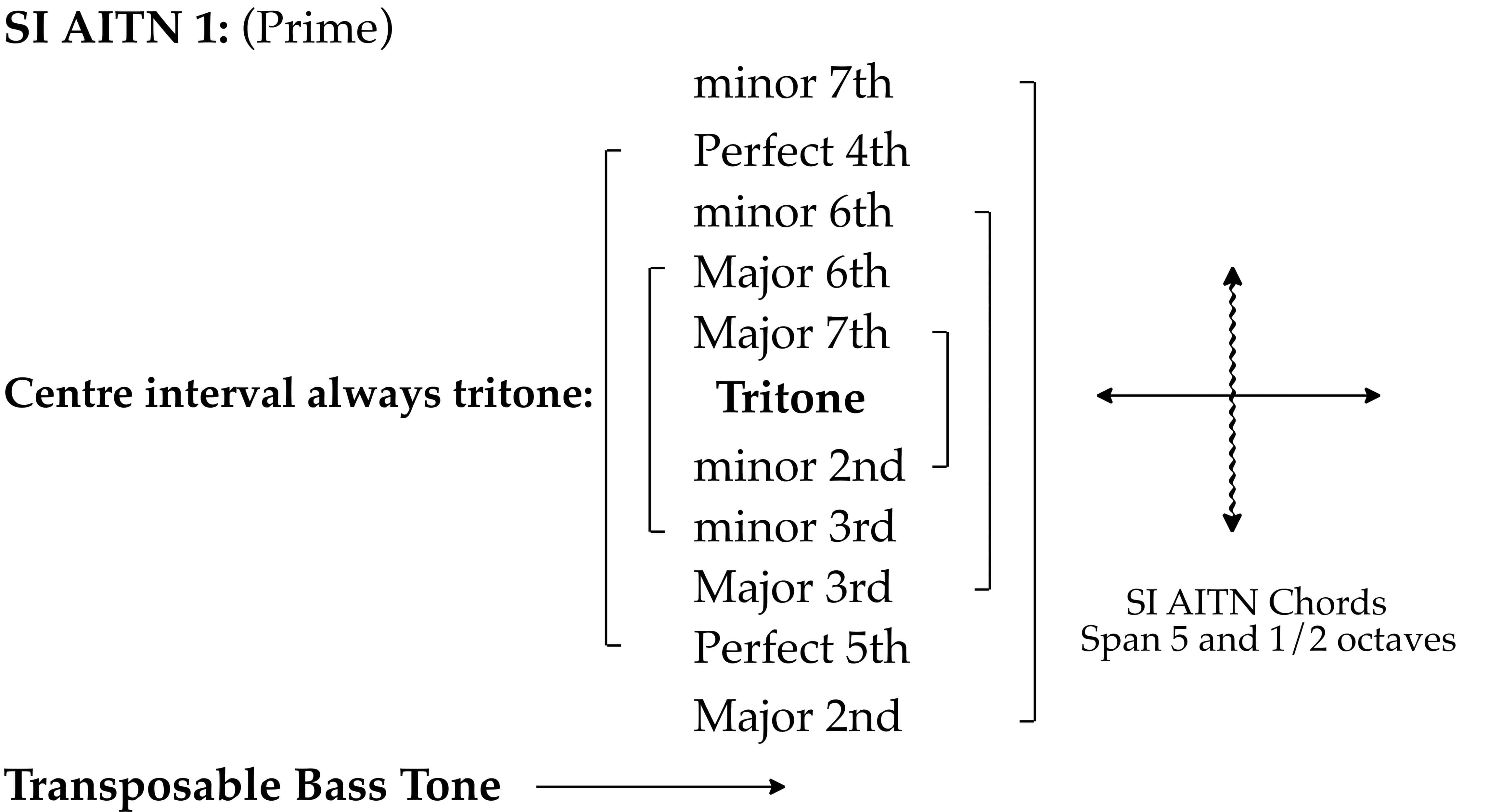
Click/Tap to View
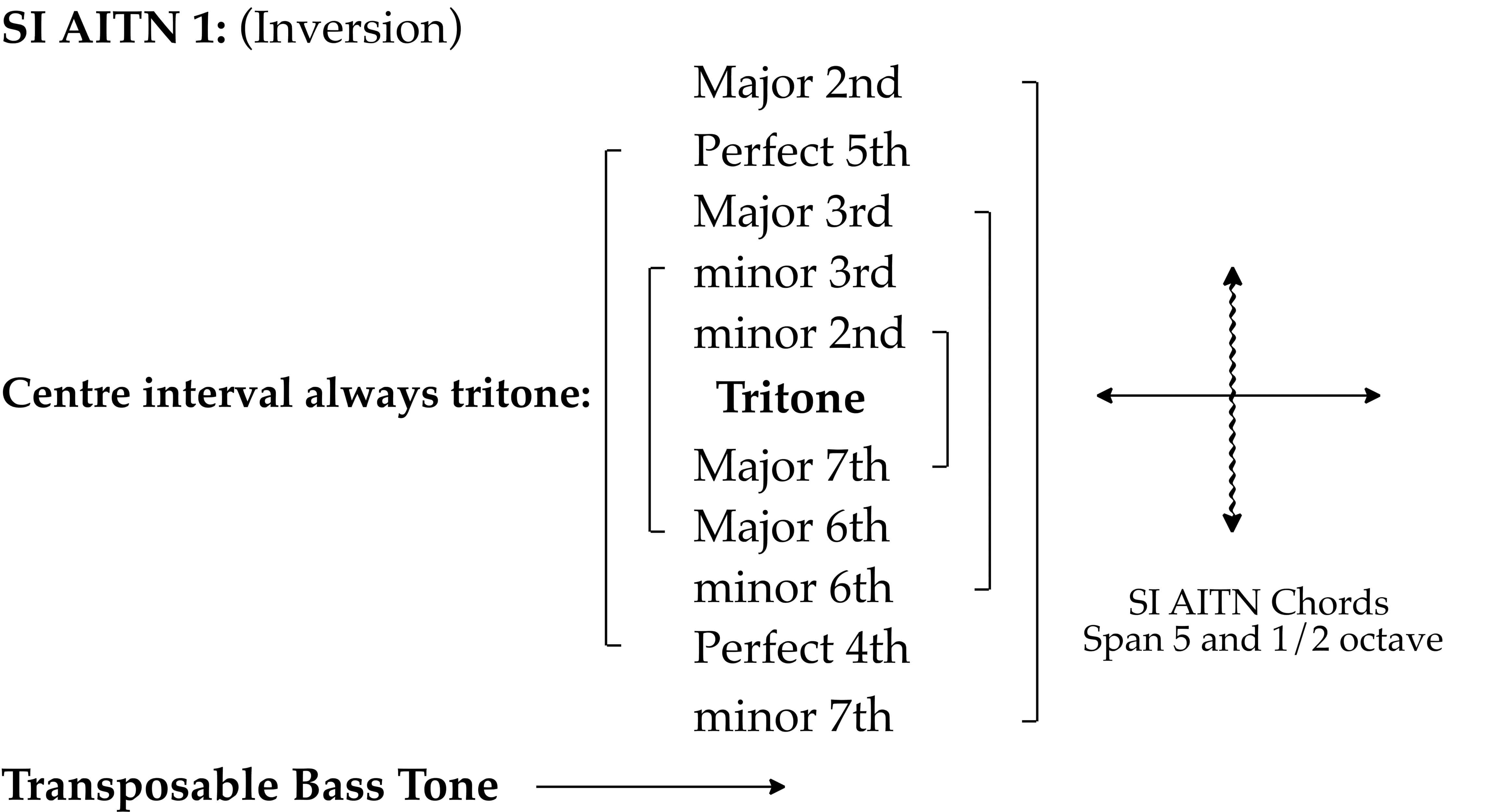
Click/Tap to View
3 Carter lists 88 but does not include inversions. Researchers have identified further alternates [Link Chords]
Sacsayhuamán
The Composition
Sacsayhuamán is composed from SI AITN 1. The tempo is marked crotchet equals 40 throughout. The work could be described as harmonically static, with the near omnipresence of the two framing pitches of the chords: C1 (contrabasses) and F#6 (violins).
The Main Movement is in a four-bar, 18-beat sequence: Prime, Retrograde, Inverted and Retrograde Inverted, which accumulates in dynamic and texture consistently towards the central extended and sustained crescendo, adding one more note of the relevant chord on each cycle. The process is then reversed after the crescendo to dissipate dynamically and harmonically in mirror-form. Harmonic motion moves between the chords: Prime occupies the first two bars and Inverted the second two bars (working from the bass up), with [R] and [I] overlapping in juxtaposition on the second and fourth bars of each cycle (working from the treble down). [P] is paired with [R] and [I] is paired with [RI] throughout. Most of the changes in chord type and density are marked in the score.
Sacsayhuamán
Main Movement Basic Form & Harmony
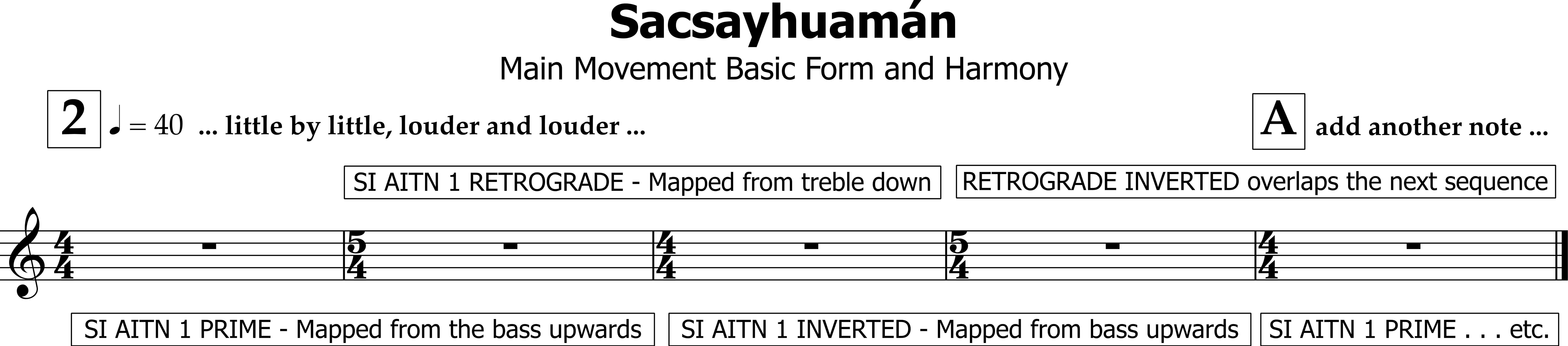
Click/Tap to View
Whilst the vertical unfolding of texture and harmonic progression in the Main Movement was fairly systematic, there were many anomalies to negotiate as the overlapping chords grew more dense (not to mention choices of orchestration and timbral balance). A basic hierarchy was adopted so that the Prime and Inverted spellings would always be preferred in times of necessary choice. Therefore, some notes of the overlapping [R] and [RI] chords were omitted from three cycles either side of the crescendo, where the continuous expansion of register (and the subsequent mirror diminution) of the two main [P] and [I] chords needed to be emphasised.
SI AITN 1 Prime:
029145 ET7386 = C – D – A – C# – E – F – B – Bb – G – D# – G# – F#
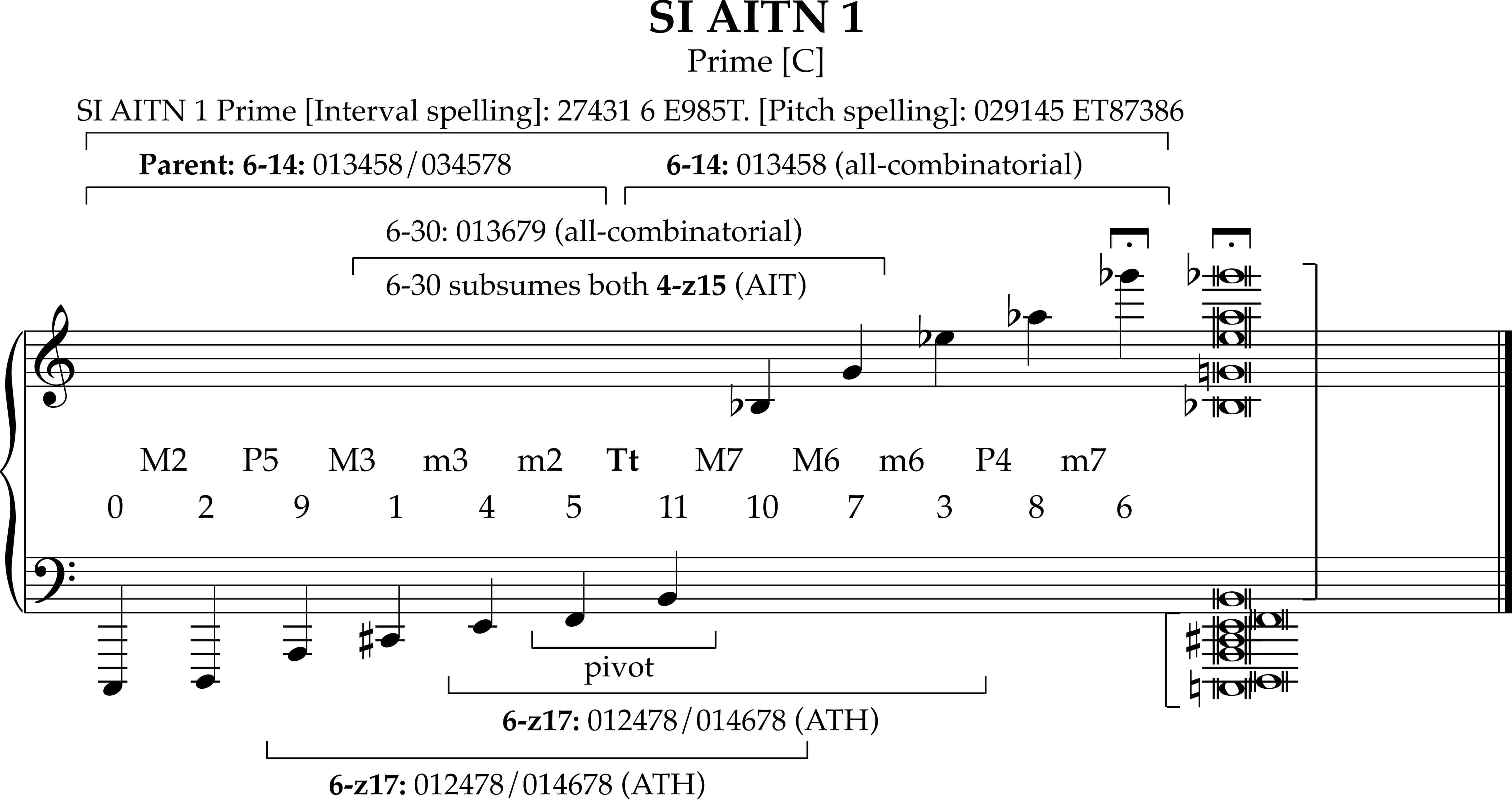
Click/Tap to View
SI AITN 1 Inverted:
0T3E87 125946 = C – Bb – Eb – B – G# – G – C# – D – F – A – E – F#
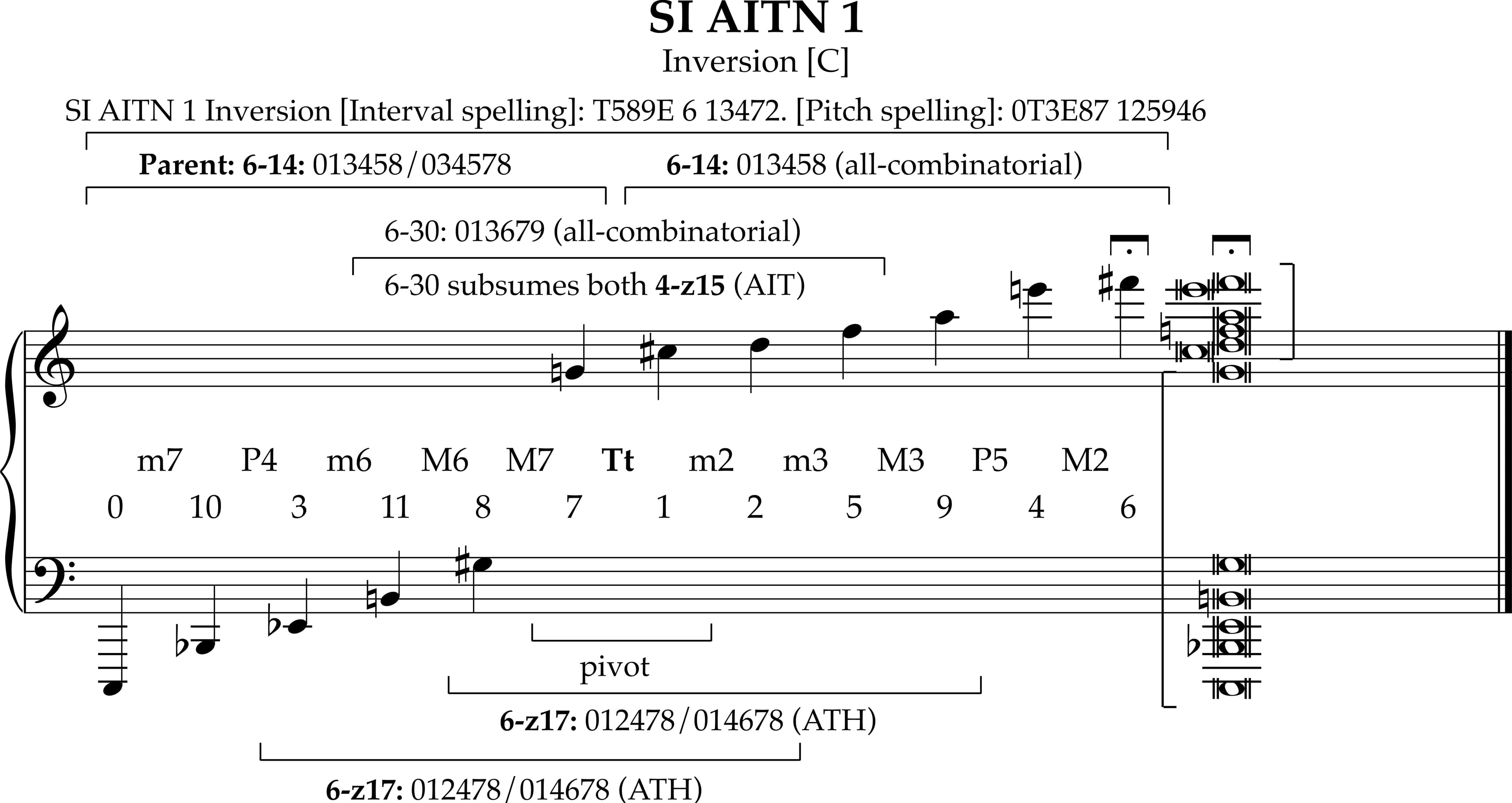
Click/Tap to View
Linear Writing:
Combined 20-note scale
Many of the linear gestures used the [P] and [I] chord-scales as fixed (or unordered) rows and subsets. Care was taken to avoid semi-tone clashes with the vertical harmony. The vibraphone concentrates upon varying elements from the combined 20-note version of the row:
C – D – A – Bb – Db – Eb – E – F – B – G# – A# – G – C# – D – Eb – F – Ab – A – E – F#
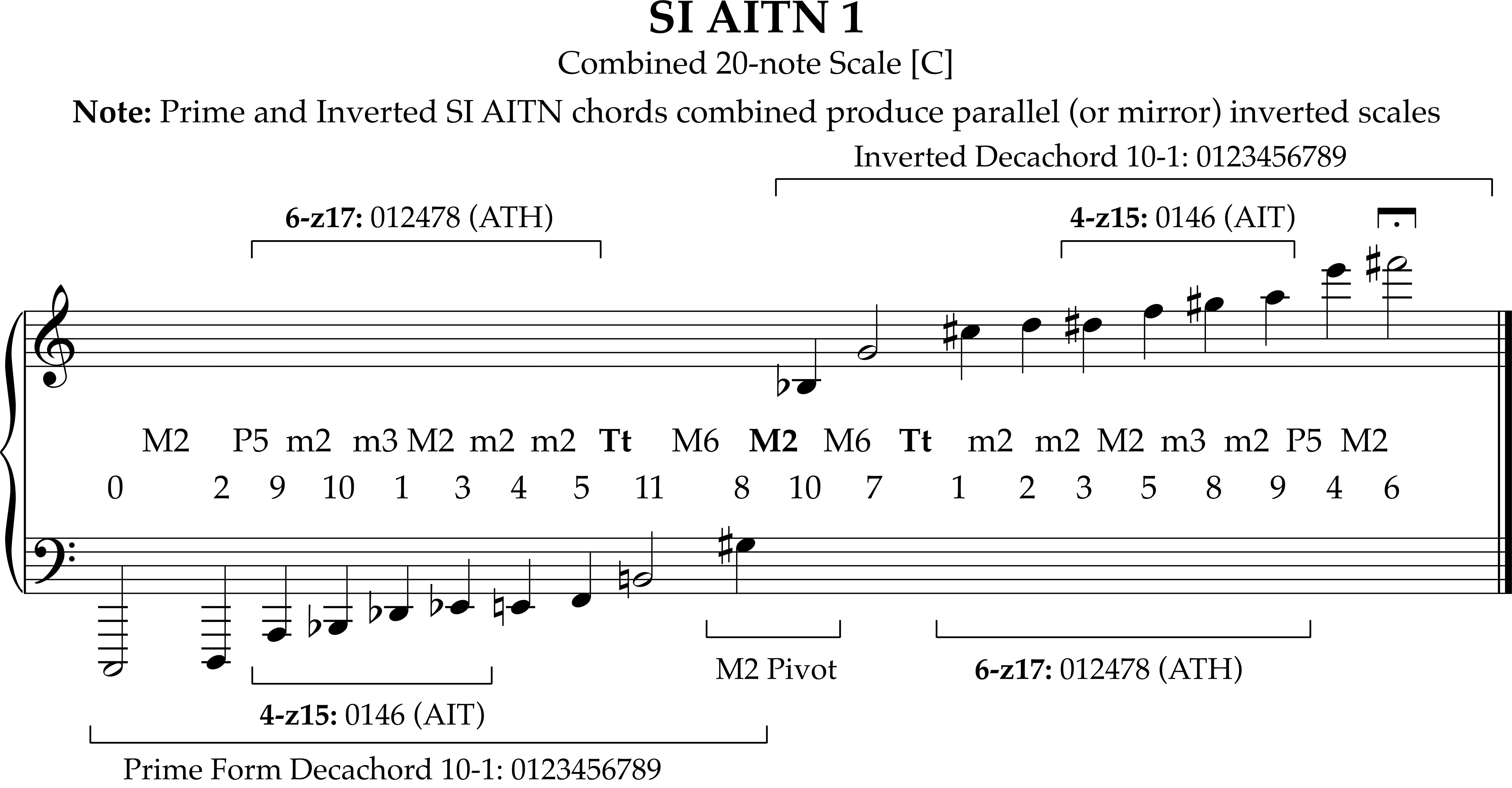
Click/Tap to View
Vertical Spaces:
Vertical space in the harmony for linear melodic and motivic materials …
Most of the linear gestures, chromatic statements and melodic material happen within the vacant vertical spaces of the combined chords, which were essentially precomposed and are present throughout. Although horizontal material always refers to the twelve and twenty note rows, composition was far more instinctive within these ‘vertical’ spaces, often using subsets and micro units of the rows as unordered cells.
Four intervals of vertical space:
C3 – G3, B3 – F#4, Ab4 – C5, Bb5 – Eb6
A Natural Anomaly:
There are four shared notes between the combined chords: C1 – B2 – G4 – F#6. The C1 and F#6 are omnipresent in the score by design and intent and quite literally frame the music. The B2 was used as the catalyst to one of the motif on the bass clarinet and therefore is diluted. This left the G4. During earlier sketches (before the vertical harmony had reached G4), the trumpets and horns (and to a lesser extent viola) had started using the note of Ab4 in an important motif/phrase. One always tries to introduce a composed anomaly into any pre-compositional system, this one presented itself naturally through the organic tendency of linear phrases, so the rogue Ab4 was embraced within the linear statements and all occurring incidents where G4 and Ab4 wanted to occupy the same acoustic space were resolved on an individual basis. Mostly deferring to the linear Ab4 to heighten the recurring blurring effect of this anomaly.
SI AITN 1 [P] and [R]: C1 - D1 - A1 - C#2 - E2 - F2 - B2 - Bb3 - G4 - Eb5 - Ab5 - Gb6
SI AITN 1 [I] and [RI]: C1 - Bb1 - Eb2 - B2 - Ab3 - G4 - C#5 - D5 - F5 - A5 - E6 - F#6
Introduction and Conclusion:
diū noctūque (by day and by night)
The Introduction and Conclusion share the same fundamental properties and four-bar cycles as the Main Movement. However, they both start in crescendo with a repeated complete SI AITN 1 Inverted chord and then essentially begin to dissipate the harmony (rotating through the chord-types) towards an ever-thinning texture and quieter dynamic. In contrast to the Main Movement, the vertical textures of the Introduction and Conclusion are far less reliant upon the harmonic method and are generally more instinctive in the approach to, and use of, passing harmony and linear statements.
In Summation:
Although this score is the result of an extended period in the composer’s life, took almost two years to simply sketch the initial framework and plot the harmonic changes into a musical form, and then numerous multiple month monastic ‘sittings’ spanning over a decade to finally reach the closing bars, it is pleasing to note that the finished music sounds alive, full of energy and ready to explore the world. It bears no scars from the battles it has put it’s composer through and actually sounds like it was always meant to be! Sometimes, things just work …